
From the Hive
How Old Do You Have to Be to Get CPR Certified
The American Red Cross has no minimum age for its standard First Aid, CPR, and AED courses. Certification depends on demonstrating the required skills. Children can also learn emergency awareness before they are ready to pass the skills assessment.
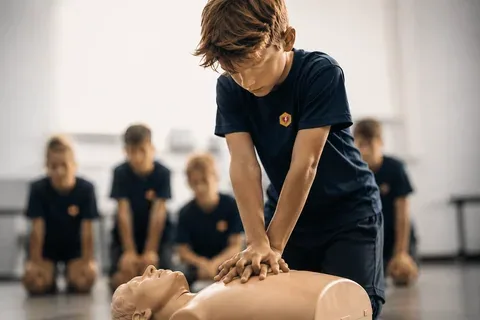
For standard American Red Cross CPR courses, there is no minimum age: a child can earn a course completion card when they can demonstrate the required skills in a hands-on check. What children can do changes with development, especially the strength needed for adult chest compressions, so the age table below helps families choose the right training.
Continue learning about Where to Find Free CPR Classes, What Basic Life Support Training Covers for Young Athletes and CPR and First Aid Training in Durham NC.
CPR certification age table: what children can learn
| Stage | What they can learn |
|---|---|
| Early childhood | Recognize an emergency, get an adult, and call 911 with help. |
| School age | Follow CPR steps, find an AED, and practice on a manikin. |
| Teen years | Demonstrate the required skills in a hands-on check when strength and technique allow. |
Getting CPR certified is not about passing a written exam or hitting an age cutoff. In a certification course, you learn to recognize an emergency, call for help, push hard and fast in the center of the chest, and use an AED. Then an instructor watches you perform those skills on a training manikin, a step called a skills check. When you demonstrate the technique correctly, you earn a course completion card that is valid for two years. Because the standard is skill, not age, the real question is whether a child can perform the steps well enough to pass the check.
What younger children can realistically master
Children can learn a great deal well before they are strong enough to certify. Even young elementary students can memorize how to call 911, describe the emergency, and answer the dispatcher's questions calmly. By the early school years, many kids can find an AED, turn it on, and follow its spoken prompts, since modern devices are designed to guide anyone step by step. Starting chest compressions comes next: a child can learn the correct hand position and rhythm long before they can push deeply enough on an adult chest. Every one of these skills matters, because in a real emergency a calm child who calls for help and fetches the AED is already saving precious time.
Why strength matters for compression depth
The one part of CPR that truly depends on physical development is compression depth. High-quality CPR on an adult means pressing the chest down about two inches, and that takes real strength and body weight. Younger children often cannot reach that depth no matter how good their technique is, which is exactly why the skills check exists. As kids grow, usually into their early teens, most gain the size and strength to compress an adult chest to the proper depth and to keep going without tiring too quickly. That is typically when a young person can meet the full certification standard, though it varies from child to child.
How BeeReady trains kids through youth sports
At BeeReady, we bring American Red Cross CPR, AED, and Basic Life Support training to the youth sporting events where families already gather. Our Bee Team model invites young volunteers to learn these skills together, practice on manikins season after season, and keep an extra layer of safety on the sidelines. Training alongside teammates makes the skills feel natural rather than intimidating, and it lets kids build toward certification at their own pace. Younger members master calling for help and using an AED, while older kids work toward the full skills check as their strength catches up.
Train together as a family
One of the best ways to prepare a child is to train as a family. When parents and kids learn side by side, everyone gains confidence, and the household has more than one person ready to act if the worst ever happens. Younger children can start with the parts they are ready for and grow into full certification over time, while older teens can certify right alongside the adults. Learning together also turns a serious topic into a shared experience rather than a scary one.
Want CPR and AED training for your league, team, or family? Reach out through our site; we would love to help your sideline get ready, whatever the ages of the kids involved. And remember: this article is educational and is not a substitute for hands-on, certified training from a qualified instructor.