
From the Hive
What Damar Hamlin Taught Youth Sports About Sideline Readiness
The fast, practiced response that saved NFL player Damar Hamlin after his 2023 cardiac arrest carries a direct lesson for youth sports. Every field needs a written emergency action plan, an accessible AED, and bystanders trained in CPR, and here is how your league can build that readiness.
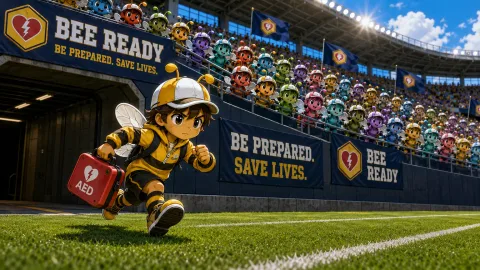
On January 2, 2023, a Buffalo Bills safety named Damar Hamlin made a routine tackle on Monday Night Football, stood up, and then collapsed. His heart had stopped. What happened next, a fast and practiced on field response, is the reason he is alive today, and it holds a lesson that reaches far beyond the NFL. Youth sports rarely have a stadium full of medical staff, yet the same simple pieces that saved Hamlin can be put in place on any sideline. His story is a chance to ask whether the fields where our children play are truly ready.
What happened to Damar Hamlin
Hamlin went into sudden cardiac arrest on the field in front of a national audience. The medical team recognized it within seconds, began CPR, and used an automated external defibrillator, or AED, to restart his heart before he was taken to the hospital. He was released about nine days later and eventually returned to professional football. Doctors later attributed the arrest to commotio cordis, a rare event in which a blow to the chest at a precise instant in the heartbeat throws the heart into a dangerous rhythm. It can happen to a healthy young person, which is exactly why it matters for youth sports.
The response that saved him was a plan, not luck
It is tempting to call Hamlin's survival a miracle, but it was really the result of preparation. Trained responders were steps away, an AED was within reach, and everyone knew their role, so the response unfolded in seconds instead of minutes. The American Heart Association calls this sequence the chain of survival: call for help, start CPR right away, and deliver a shock with an AED as fast as possible. Every link was ready that night. The outcome was not luck. It was a system working the way it was designed to.
Why youth sports needs the same readiness
Sudden cardiac arrest is one of the leading causes of death in young athletes, and when it strikes on a youth field the nearest ambulance is often minutes away. In those minutes the people closest to a collapsed child are coaches, parents, and volunteers, not team physicians. That is the gap Hamlin's case exposes. Project Play, the youth sports initiative of the Aspen Institute, noted that this level of readiness is far less common in youth and high school sports, and reported that in 2021 only about four in ten youth coaches said they had been trained in CPR in the past year. Readiness cannot be assumed. It has to be built.
A wave of awareness and advocacy
Hamlin's collapse became a national teachable moment. In the days that followed, interest in CPR and AEDs surged across the country, and course sign ups and questions about how to obtain a defibrillator rose sharply. Hamlin turned his recovery into a mission, supporting the federal Access to AEDs Act, which aims to help schools obtain and use defibrillators, and using his foundation to fund CPR education and donate AEDs to youth sports teams. The larger push was simple and durable: put more defibrillators where people play, and teach more bystanders how to act.
A grassroots echo on a youth soccer field
That push is already saving lives at the grassroots level. In June 2025, a youth soccer coach named Andrew Pihlblad collapsed in cardiac arrest during a match at a school field in Wilson, New York. A retired state trooper watching from the stands called out for anyone trained in CPR, and several spectators stepped in, some starting chest compressions while others ran to fetch the school AED. The device delivered several shocks before Pihlblad regained consciousness. He survived because ordinary people knew what to do and an AED was on site. As he told ABC News, the same thing that happened to Damar happened to him, and he was saved by everyday people who happened to be ready.
Concrete takeaways your league can act on
The lesson of Damar Hamlin translates into a short checklist any league can adopt. First, write a venue emergency action plan that names who calls 911, who starts CPR, who retrieves the AED, and who guides EMS to the field. Second, make sure an AED is on site and reachable in seconds, not locked in a distant office, and keep its pads and battery current. Third, get your coaches, officials, and as many parents as possible trained in CPR and AED use, and practice the plan so it becomes muscle memory. None of this requires a stadium budget. It requires a decision to be ready.
Damar Hamlin survived because a plan, a device, and trained people were all in place at the moment they were needed. Every youth league can put those same pieces on its own sideline. BeeReady is a physician led 501(c)(3) nonprofit that brings American Red Cross CPR, AED, and Basic Life Support training, along with AED devices, to the youth sporting events where families already gather. If you help run a league, coach a team, or simply want your family ready, reach out through our site and we would love to help. And please remember, this article is educational and is not a substitute for hands on, certified training from a qualified instructor.