
From the Hive
AEDs in Athletics: Defibrillators for Sports Facilities and Stadiums
Choosing AEDs for a sports facility starts with access: where people play, who can retrieve a device, and how responders will reach every field, court, or pool. This guide covers equipment, placement, training, and funding help for youth leagues.
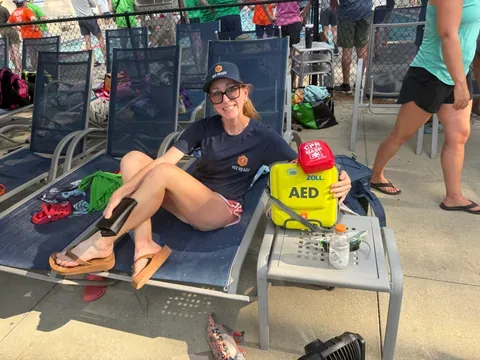
Sudden cardiac arrest is one of the leading causes of death in young athletes, and it can strike on any field, court, or pool deck. For the people who run athletic programs, that makes an automated external defibrillator (AED) essential equipment, not an optional extra. This guide is for athletic directors, facility managers, and league administrators weighing AEDs in athletics: why every program needs them, how many AED units a facility should have, what to look for in a defibrillator, and how to cover a full sports stadium.
Continue learning about How to Use an AED: A Step by Step Guide, AED Maintenance 101: Keeping Your Device Ready to Save a Life and Real Saves: Young Athletes Rescued by an AED and Fast CPR.
What an AED does
An AED is a portable device that checks the heart rhythm and, if needed, delivers a shock to restore a normal beat. Modern AEDs are designed for ordinary people to use. They give clear spoken instructions step by step, and they will not deliver a shock unless one is needed.
Why athletics programs need an AED on site
When a heart stops, survival falls with every minute that passes without defibrillation. Emergency medical services do everything they can, but response times to a sports complex, a remote field, or the far end of a stadium can stretch well past the window where a shock does the most good. A defibrillator already on site, in the hands of someone ready to use it, is what closes that gap. That is why leading sports medicine and heart health organizations recommend that every athletic venue have an emergency action plan built around an accessible AED.
How many AED units a sports facility needs
There is no single number that fits every venue, because the right count comes down to one goal: an AED should be reachable within about three minutes, round trip, from anywhere athletes compete. A small single-field club may be covered by one well-placed unit. A multi-field complex, a large gym, or a stadium usually needs several AED units so no corner of the property is out of reach. Walk the site as if the emergency were happening at its most distant point, time how long it would take to run to the nearest device and back, and add units until that time drops under three minutes everywhere.
Choosing a defibrillator for athletic settings
Defibrillators for athletics face conditions a lobby cabinet never sees: heat, cold, rain, dust, and constant moving between locations. Look for a rugged, portable unit with a high dust and water resistance rating, clear voice and visual prompts, and a long-lasting battery with a visible readiness indicator so staff can confirm at a glance that it is ready. Because athletics span every age group, choose a device that supports both adult and pediatric pads or has a child mode, so it is ready for younger athletes as well as adult coaches and spectators. A weatherproof outdoor AED cabinet keeps the unit protected and visible at fields and outdoor stadiums.
AEDs for sports stadiums and large venues
A stadium adds a second challenge on top of the field: thousands of spectators. Sudden cardiac arrest strikes fans in the stands as often as athletes on the field, so coverage has to include concourses, seating areas, and entrances, not just the sidelines. Mount AED units in clearly signed, evenly spaced cabinets along public walkways, register each one with local emergency dispatch so 911 operators can point callers to the nearest device, and mark them on venue maps and signage. The goal is simple: no seat in the stadium should be more than a short walk from a defibrillator.
Sudden cardiac arrest happens to young athletes too
It is a myth that cardiac arrest only affects older adults. Sudden cardiac arrest is one of the leading causes of death in young athletes, and the conditions that cause it often have no warning signs. That is exactly why preparation, not just hope, is what protects kids.
Equipment is only half the plan
An AED saves lives only when someone nearby is ready to grab it and act. The most reliable venues pair their defibrillators with a written emergency action plan and with staff, coaches, and volunteers trained to recognize cardiac arrest, call for help, start CPR, and use an AED without hesitation. That is the combination BeeReady brings to youth sports: we help place AEDs where kids play and train the people around them through American Red Cross CPR, AED, and Basic Life Support courses, so equipment and skills arrive together.
Do you run an athletic program, facility, or league that wants AEDs and trained responders on your sidelines? Reach out through our site and we would love to help your venue get ready. And remember: this article is educational and is not a substitute for hands-on, certified training from a qualified instructor or for professional guidance on your venue's emergency action plan.